By TPD Admin
 March 28, 2026
The travel industry has witnessed a seismic digital transformation over the past decade. Whether you are an established travel agency, a startup OTA (Online Travel Agency), or a corporate travel management company, having the right online booking portal is no longer optional - it is a business necessity.
But here is the most common question we hear from travel entrepreneurs and technology decision-makers:
"Should I build a B2B travel portal or a B2C travel portal - and what is the difference?"
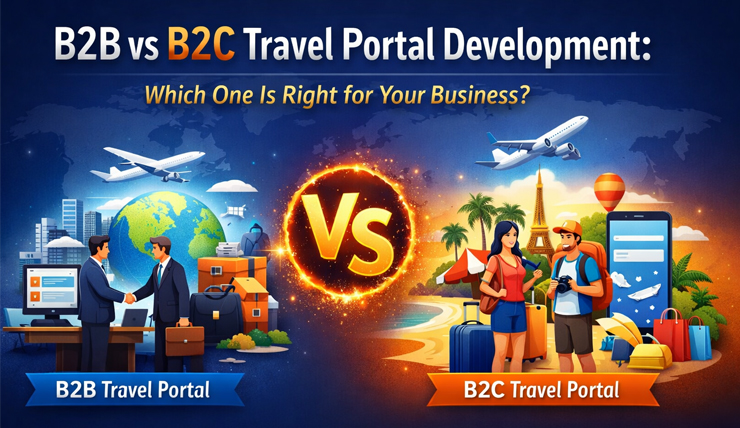
In this comprehensive guide, we break down B2B vs B2C travel portal development - their features, target audiences, technology stacks, business models, and which option is the right fit for your business goals in 2026.
A B2B (Business-to-Business) travel portal is an online platform that enables travel businesses to sell travel products and services to other businesses, rather than directly to end consumers. These businesses include:
A B2C (Business-to-Consumer) travel portal is an online booking platform that allows end travelers to search, compare, and book travel services directly. Think of platforms like MakeMyTrip, Booking.com, Expedia, or Cleartrip - these are all B2C travel portals at scale.
B2C travel portals focus heavily on user experience (UX), conversion rate optimization (CRO), and digital marketing to drive traffic and bookings.
A B2C (Business-to-Consumer) travel portal is an online booking platform that allows end travelers to search, compare, and book travel services directly. Think of platforms like GoldenAgers.in, indiafly.com, Expedia, or Cleartrip - these are all B2C travel portals at scale.
B2C travel portals focus heavily on user experience (UX), conversion rate optimization (CRO), and digital marketing to drive traffic and bookings.
| Feature | B2B Travel Portal | B2C Travel Portal |
|---|---|---|
| Target Audience | Travel agents, corporates, wholesalers | Direct end travelers / consumers |
| Pricing Model | Net rates, negotiated fares | Published retail prices |
| User Volume | Fewer but high-value users | Mass users with smaller transactions |
| Integration | GDS, XML/API, wholesale inventory | OTA APIs, metasearch, aggregators |
| Payment | Credit line, invoicing, bulk billing | Credit/debit card, UPI, wallets |
| Commission | Markup management tools | Not applicable |
| Booking Flow | Complex, multi-step | Simple & fast |
| White Label | Common requirement | Rare |
If you are planning B2B travel portal development, make sure your platform includes these must-have features:
A B2C online booking engine needs to be intuitive, fast, and conversion-focused. Essential features include:
Both B2B and B2C travel portals require a robust, scalable tech stack. Here is what most leading travel technology companies use in 2026:
Travel portal development costs vary significantly based on scope, features, integrations, and the development company you choose. Here is a general estimate for 2026:
B2B Travel Portal: Basic Version:- $8,000 – $15,000 | Full-Featured:- $20,000 – $60,000+
B2C Travel Portal: Basic Version:- $10,000 – $20,000 | Full-Featured:- $30,000 – $100,000+
Combined B2B + B2C: Basic Version:- $15,000 – $25,000 | Full-Featured:- $50,000 – $150,000+
Now for the critical question - do you need a B2B portal, a B2C portal, or both? Here is a simple decision framework:
Many successful travel companies - like Yatra, Goibibo, and regional OTAs - operate both B2B and B2C portals under the same brand umbrella to capture maximum market share.
Whether you choose B2B, B2C, or a hybrid travel portal, the success of your platform depends on three things: the right technology, the right integrations, and the right development partner.
B2B travel portals are ideal for businesses that serve the trade channel - agents, corporates, and wholesalers. They require complex backend systems, credit management tools, and deep GDS integrations.
B2C travel portals on the other hand, demand a laser focus on user experience, mobile optimization, fast load times, and digital marketing readiness. They are consumer-facing engines built to convert visitors into paying travelers.
In 2026, the most competitive players in the travel tech space are those who invest in scalable, API-first architectures that can serve both B2B and B2C markets. If budget allows, a combined platform gives you the ultimate competitive advantage.
Before starting development, map out your business model clearly, identify your target users, define your revenue streams, and work with an experienced travel portal development company that understands both GDS integrations and modern UI/UX standards.
The right portal is not just software - it is your digital business engine.
A B2B travel portal connects travel businesses (agents, corporates) and deals with net rates, markups, and agent management. A B2C travel portal sells directly to end consumers using retail pricing, loyalty programs, and consumer-friendly UX.
A basic B2B or B2C travel portal development typically costs between $8,000 and $20,000. A full-featured platform with GDS integration, mobile apps, and advanced features can range from $30,000 to $150,000 depending on scope, team size, and location.
GDS (Global Distribution System) integration connects your travel portal to real-time flight, hotel, and car rental inventory from systems like Amadeus, Sabre, and Travelport. It is essential for accessing live pricing and availability.
A basic travel portal can be launched in 3 to 4 months. A full-featured B2B or B2C travel portal with GDS integration, payment gateway, and mobile app typically takes 6 to 12 months to develop and launch.
Yes. Many travel technology companies build combined B2B + B2C portals using a shared inventory and backend, with separate frontends for agents and consumers. This hybrid approach maximizes revenue channels and is the preferred model for scaling OTAs.
Common APIs include: Amadeus Travel API, Sabre Dev Studio, Travelport Universal API, Hotelbeds API, Expedia Partner Solutions API, Mystifly for flights, and payment APIs like Stripe, Razorpay, and PayPal.
White-label travel portals are a great option for startups and small agencies as they are faster to launch and more cost-effective than custom development. However, custom portals offer greater flexibility, scalability, and branding control for growing businesses.
The best tech stack depends on your requirements. Most modern travel portals use React.js or Next.js for the frontend, Node.js or Python for the backend, PostgreSQL or MongoDB for databases, and a microservices or API-first architecture for scalability.
What are the key features to include in a travel portal website?
June 11, 2025
Simplifying Travel Bookings: A Comprehensive Guide to B2C and B2B Portal Website Development
May 10, 2025
Revolutionize Your Travel Business with Cutting-Edge Travel Portal Website Development Strategies!
July 20, 2024
Top 10 Flight Booking API Providers for Your Travel Business
July 12, 2024
Top 10 Flight Booking API Providers for Your Travel Business
July 12, 2024
Maximize Your Travel Agency's Potential with Expert Travel Portal Website Development
July 06, 2024
The Ultimate Guide to Dominating the Online Travel Market: How to Create a Successful Travel Portal Website
June 18, 2024
Unlock the Secrets to Successful Travel Portal Website Development for Your Travel Agency!
May 13, 2024
Stay Ahead in the Travel Industry with Our Customized White Label Travel Portal Development
April 11, 2024
What is Hotel Booking Engine – Why You Need One in 2024 for travel agent?
March 09, 2024
Expert Travel Portal Development Services | Get Started
February 09, 2024
How to Overcome the Challenges of Developing a Travel Portal Website
January 12, 2024
How To Start An Online Travel Agency Website?
December 15, 2023
5 Key Factors to Consider When Choosing a Travel Portal Development Company
October 27, 2023
Transform Your Travel Business: Build a Dynamic Travel Portal
October 10, 2023
The Benefits of Custom Travel Portal Development for Your Travel Business
August 02, 2023
Unlock the Potential of Your Travel Portal with White Label Solutions
July 12, 2023
How to Choose the Right White Label Travel Portal for Your Travel Agency?
June 06, 2023
White Label Travel Portals vs. Customized Travel Portals: Which is Right for Your Business?
April 07, 2023
Expand your Brand Reach with White Label Travel Portal Development
April 12, 2021
Why Travel Agents Should Use B2B White Label Travel Portal?
March 12, 2021
How to Enable A Better Traveler Experience with Travel API
February 28, 2021
What is A Travel API and How It Benefits Travel Agencies?
February 13, 2021
Why Travel Agents Must Opt for A White Label Travel Portal?
January 28, 2021